
Before there was a digital passbook, there was the paper one.
Before South African apartheid bureaucratized racial control, American slavery perfected it.
Before algorithms automated sorting, Jim Crow demonstrated how to make violence procedural, denial administrative, and segregation seem like neutral policy optimization.
The morning Latoya’s algorithm decided she was ineligible, it wasn’t inventing anything. It was inheriting everything.
To understand Technocratic Neo-Apartheid™ requires understanding that apartheid—South African, algorithmic, or otherwise—did not invent racialized administrative control. It learned from the system that did: American slavery, followed by American segregation, refined through South African formalization, and now digitized through algorithmic governance that deploys the accumulated techniques at speed and scale previously unimaginable.
The plantation ledger became the Jim Crow ordinance became the apartheid passbook became the credit score.
The slave pass became the segregation permit became the movement documentation became the risk assessment algorithm. The auction block’s sorting became redlining’s mapping became predictive policing’s classification.
This is not metaphor. This is material inheritance.
The Original Passbook: American Slavery’s Administrative Infrastructure
Enslaved people required written permission to move beyond plantation boundaries. The pass system determined who could travel, under what conditions, for what purpose, and for how long. Plantation owners maintained detailed ledgers cataloging human beings as inventory—names, ages, skills, monetary value, reproductive capacity. Free Black people in both North and South faced documentation requirements that white citizens did not. In many jurisdictions, freedom papers had to be carried at all times and produced on demand. The penalty for lacking proper documentation was re-enslavement.
This was not incidental cruelty. This was administrative technology designed to manage populations through continuous verification of status. The logic was elegant in its violence: make freedom conditional on documentation, make documentation subject to inspection, make inspection ubiquitous, and the entire system becomes self-enforcing. Any Black person could be stopped at any time and required to prove they belonged where they were. The burden of proof rested with the documented, not the documenter.
The pass system operated as continuous pre-clearance. Rights were not inherent—they were granted conditionally, revocable instantly, and required ongoing verification through bureaucratic process. Movement, employment, family life, and survival itself became functions of administrative approval that could be withdrawn without explanation or appeal. The plantation ledger didn’t just record who was enslaved. It established the infrastructure for determining who counted as human and who counted as property, then made that determination portable, searchable, and enforceable at scale.
This is the original digital passbook—not digital in the computational sense, but digital in the bureaucratic sense. Documentation that travels with the person. Classification that determines access. Sorting that happens before the interaction. Administrative process that replaces individual decision-making with systematized denial.
When we talk about algorithmic governance inheriting racialized control, we are not speaking abstractly. We are tracing a direct line from the plantation ledger that categorized Black people as inventory, to the pass system that made Black freedom conditional on documentation, to the administrative infrastructure that treats both as models for optimization.
Jim Crow as Administrative Apartheid
The formal end of slavery did not end the administrative infrastructure slavery created. It adapted. Convict leasing replaced plantation labor by criminalizing Black life and leasing the imprisoned to private industry. Black Codes restricted employment, movement, and property ownership through laws that appeared race-neutral but targeted with precision. Vagrancy statutes made unemployment a crime, then denied Black workers access to most jobs. Poll taxes and literacy tests made voting rights conditional on bureaucratic hurdles designed to be insurmountable.
But the most sophisticated development of racialized administrative control came through segregation itself. Jim Crow was not primarily about personal prejudice or social custom. It was about bureaucratizing apartheid—making racial stratification procedural, automatic, and legally defensible as mere policy enforcement.
Segregation operated as continuous pre-clearance at every level of social infrastructure. Schools, hospitals, transportation, employment, housing, public facilities—all required determining who belonged where before access could be granted. The system sorted populations in advance, assigned them to separate and profoundly unequal infrastructure, and enforced those boundaries through violence disguised as policy compliance. When Black families were denied housing in white neighborhoods, the denial came wrapped in language of property values, neighborhood character, and objective standards. When Black workers were excluded from employment, the exclusion appeared as skills requirements, experience preferences, and neutral qualifications. When Black children were relegated to under-resourced schools, the justification was separate but equal—a bureaucratic fiction that made inequality seem like balanced administration.
Redlining formalized this logic as federal policy. The Home Owners’ Loan Corporation created residential security maps that color-coded neighborhoods by risk level. Black neighborhoods received red designations indicating “hazardous” investment risk regardless of actual economic conditions. These maps determined which communities could access mortgages, where banks would lend, which areas received infrastructure investment, and where wealth accumulation became structurally possible. The classifications appeared objective—based on property values, neighborhood composition, and economic indicators. But property values reflected segregation. Neighborhood composition reflected forced containment. Economic indicators reflected systematic exclusion from employment and credit.
The map didn’t describe risk. It created it. Then it used that creation to justify ongoing denial.
This is the administrative logic that South Africa studied when constructing apartheid. American segregation demonstrated how to make racial stratification appear as neutral bureaucracy, how to automate denial through procedural requirements, how to make violence administrative rather than spectacular, how to render appeal impossible by diffusing responsibility across institutional process. The genius of Jim Crow was not its cruelty—though cruelty was pervasive—but its bureaucratization. It transformed white supremacy from ideology requiring constant violent maintenance into administrative infrastructure that could claim color-blindness while producing racially stratified outcomes with mechanical consistency.
When apartheid architects spoke of separate development and objective standards and administrative necessity, they were speaking the language Jim Crow perfected. When they implemented the passbook system, they were scaling American innovation.
South African Apartheid: Formalizing An American Future
South African apartheid was American Jim Crow with centralized state power and explicit racial classification replacing the fiction of separate but equal. The passbook system—mandatory documentation determining where Black South Africans could live, work, travel, and exist—operated as continuous pre-clearance at national scale. The document contained photographs, fingerprints, employment history, tax records, and encounters with authorities. It had to be carried at all times and produced on demand. Failure to present valid documentation meant immediate detention.
The system did not need to justify denial in each instance. It sorted populations in advance through administrative classification that determined eligibility before the interaction. Rights became conditional on documentation status updated in real time by state bureaucracy. Access required approval granted or withheld through administrative process immune to appeal. Movement required permission verified at checkpoints distributed throughout daily geography.
Apartheid’s architects explicitly studied American segregation. They visited the United States, examined Jim Crow legislation, analyzed how the American South maintained racial hierarchy through law rather than solely through violence, and imported those techniques. What they admired was not the ideology—though they shared that—but the administrative efficiency. American segregation demonstrated that you didn’t need to announce racial domination as overt policy goal. You could achieve it through bureaucratic process that appeared neutral, objective, and simply administrative.
The passbook system was this logic at scale. It centralized what Jim Crow distributed across thousands of local jurisdictions. It made explicit what American segregation implied. It formalized what redlining accomplished through private coordination. But the underlying logic was identical: make rights conditional, make access bureaucratic, make denial procedural, make appeal impossible, and call the entire system objective administration.
Apartheid was not innovation. It was formalization—taking techniques developed through American slavery and segregation, centralizing them under state power, removing the pretense of legal equality, and deploying them with industrial efficiency. The genius of apartheid as control technology was not brutality—though brutality was constant—but bureaucratization at scale. Violence became administrative. Exclusion became procedural. Segregation became optimization.
When the apartheid state announced that someone was denied housing, employment, or freedom of movement, it did not say “we deny you because you are Black.” It said “your documentation does not satisfy eligibility requirements.” The result was identical. The rhetoric was neutral. The system appeared as administration rather than domination.
This is what algorithmic governance inherits: not just the sorting logic, but the rhetorical insulation. Not just the denial mechanism, but the claim to objectivity. Not just the continuous pre-clearance, but the diffusion of responsibility into procedural complexity that renders accountability impossible.
The Digital Passbook Takes an Algorithmic Turn
Contemporary algorithmic systems do not invent racialized control. They digitize it. They accelerate it. They deploy at computational speed what five centuries of administrative violence already perfected: sorting populations, pre-clearing access, making denial procedural, and calling it objective.
Credit scoring systems determine financial access before application. The algorithms incorporate payment history, debt ratios, account age, and credit utilization—variables directly reflecting historical redlining, employment discrimination, and wealth extraction. When machine learning systems optimize lending decisions within these parameters, they do not correct inequality.
They operationalize centuries of racial capitalism as eligibility determination. Black and Latino applicants are denied mortgages at rates significantly higher than white applicants with identical financial profiles. This is not bias in the colloquial sense—individual prejudice requiring elimination through better training. This is inherited stratification formalized as risk management.
The algorithm does not create the disparity. It inherits the social structure that designated certain communities as credit risks through enforced segregation, differential access to employment and education, and systematic wealth extraction. The redlining maps that determined which neighborhoods were investment-worthy and which were hazardous still operate—not as paper documents but as data distributions the algorithm learns from. When the system denies the loan, it reproduces Jim Crow as finance, apartheid as creditworthiness. The denial letter says “based on objective criteria” just as the apartheid passbook said “documentation does not satisfy requirements.” The language is neutral. The inheritance is five centuries old.
Predictive policing systems determine surveillance intensity before incident. Algorithms identify “high-risk” neighborhoods requiring intensified patrol saturation and proactive intervention. These neighborhoods are not randomly distributed. They are communities subjected to generations of over-policing, where elevated arrest rates reflect enforcement asymmetry rather than underlying criminality. When the algorithm directs additional police presence to these areas, it does not predict crime. It manufactures it through intensified contact, expanding the dataset that will justify future deployments.
Research published in Science demonstrates that these systems create recursive feedback loops. Prediction drives deployment. Deployment generates arrests. Arrests validate prediction. The cycle accelerates. The system does not discover crime. It produces it through administrative logic impervious to challenge. This is the slave patrol digitized—the system that monitored Black movement, enforced pass requirements, and created criminality through the act of surveillance itself. The algorithm inherits not just the data but the function: continuous monitoring of populations designated as threats requiring containment.
Algorithmic management systems determine pace, pay, and termination before human review. In logistics warehouses serving Amazon, Target, and Walmart, electronic monitoring tracks worker movement at second-level granularity. Performance scoring systems classify employees as underperforming based on metrics calibrated to rates that predictably injure. Workers receive termination notices generated automatically without managerial oversight. The UC Berkeley Labor Center documents injury rates in algorithmically managed warehouses at nearly double the industry average. Job tenure collapses. Worker churn accelerates.
These systems disproportionately govern racialized labor markets—facilities located in majority-Black and Latino communities where employment alternatives have been systematically eliminated through deindustrialization, capital flight, and economic abandonment. The algorithm does not create disposable labor. It administers populations already designated as such. This is convict leasing without the conviction—the logic that treated Black bodies as machinery to be optimized for extraction and discarded when they broke. The performance metric inherits the plantation ledger’s function: cataloging human beings as units of production, measuring their value in output rates, and disposing of them when they fall below optimized thresholds.
Housing allocation algorithms used by public housing authorities and private landlords incorporate criminal records, eviction histories, credit scores, and employment gaps. Each variable reflects racialized enforcement asymmetry. Black Americans are incarcerated at five times the rate of white Americans despite similar rates of drug use. Eviction filings target Black women at rates grossly disproportionate to housing stock. Employment discrimination remains pervasive despite legal prohibition. When algorithms optimize tenant selection using these inputs, they do not introduce bias into a neutral system. They automate the logic that produced segregation, ensured its persistence through ostensibly race-neutral mechanisms, and now deploys machine learning to accelerate denial.
Families become ineligible before application. Appeals require navigating proprietary systems immune to meaningful oversight. Homelessness becomes administratively inevitable. This is redlining as real-time sorting—the map that determined which neighborhoods were investment-worthy now operates as algorithm determining which families are housing-worthy. The classification appears objective. The inheritance is direct.
Border risk assessment systems determine who moves, who waits, and who disappears into detention before arrival. U.S. Customs and Border Protection deploys algorithms analyzing travel patterns, visa histories, social media activity, and biometric data to generate risk scores. High-risk classifications trigger secondary inspection, device searches, denial of entry, or indefinite detention. These systems do not distribute risk categorization evenly. They target populations from nations the United States has destabilized through military intervention, economic sanctions, and resource extraction. They operationalize imperial geography as administrative sorting.
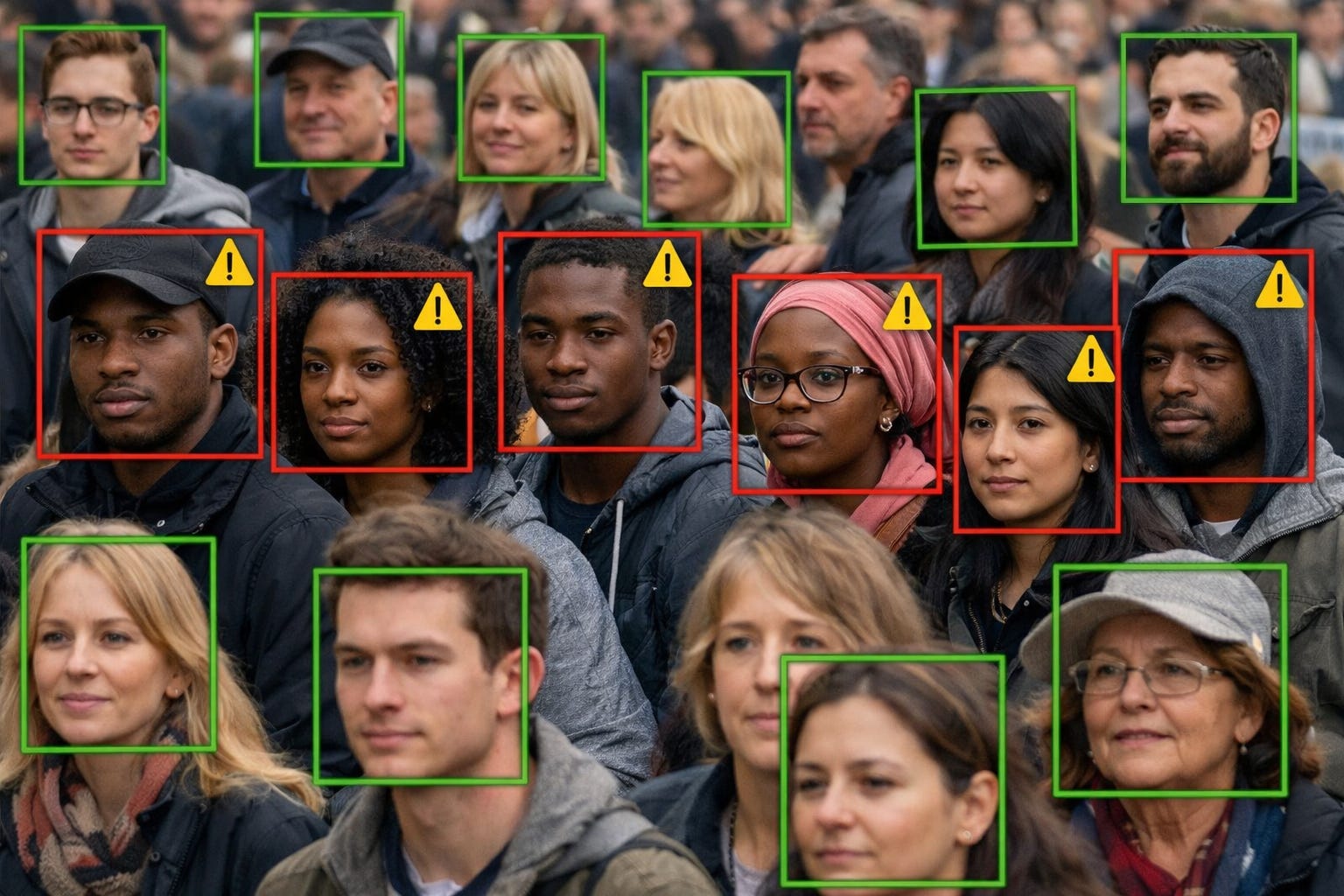
The algorithm does not assess objective threat. It formalizes decades of racialized border enforcement as predictive governance. National Institute of Standards and Technology research demonstrates that facial recognition systems—now deployed across these domains—produce false-positive rates for Black women up to 35% higher than for white men in one-to-many identification scenarios. A false positive at a checkpoint is not inconvenience. It is interrogation. Detention. Denial. Arrest. Death. This is not technical malfunction. This is racialized sorting functioning as designed—the pass system digitized, the checkpoint automated, the documentation requirement embedded in biometric capture that happens whether you consent or not.
Palestine as Brutal Inhumane Laboratory
When Israeli occupation forces deploy Blue Wolf, a facial recognition application cataloging Palestinians through smartphone-based checkpoints, they are using technology that operates without the liberal pretense that constrains similar systems in the United States. Soldiers photograph faces. The system matches against databases linking individuals to threat classifications generated through pattern-of-life surveillance. Israeli forces gamify participation—soldiers who photograph and upload the most Palestinian faces receive public recognition and material rewards. Every interaction becomes data capture. Every checkpoint becomes enrollment. Movement requires algorithmic pre-clearance updated in real time.
Lavender, an AI targeting system developed by the Israeli military’s elite intelligence unit, identifies Palestinians for assassination. The algorithm analyzes communication patterns, movement data, social networks, and behavioral indicators to generate kill lists. Human operators spend an average of 20 seconds reviewing each recommendation before authorizing airstrikes. This is not human-in-the-loop as meaningful oversight. This is automated execution with bureaucratic formality preserving the fiction of deliberation. Investigations by +972 Magazine and Local Call document that Israeli forces knowingly accept high civilian casualty ratios in strikes authorized through this system. When targeting lower-ranked Hamas members, military protocol permits killing up to 15-20 civilians per strike. For senior operatives, that ratio expands to hundreds.
The algorithm does not minimize civilian death. It administers mass killing with procedural legitimacy. Red Wolf tracks Palestinian vehicles. Gospel analyzes building structures to recommend bombing targets. The Alchemist determines optimal strike timing based on likelihood of finding targets at home with their families. WhatsApp content moderation suppresses Palestinian documentation while permitting open calls for genocide. Economic gatekeeping determines who can work, bank, transfer money, or trade.
These systems do not function in isolation.
They operate as integrated infrastructure for total administrative control. Palestinians cannot move without algorithmic permission. Cannot work without classification as eligible. Cannot communicate without surveillance capture. Cannot resist without automated targeting. Cannot document without platform suppression. This is apartheid administered through AI at speed and scale previously impossible.
But it is not exceptional. It is revelatory.
Palestine matters not becase it invented these techniques but because it reveals them operating without the rhetorical constraints that obscure their function elsewhere. Blue Wolf is predictive policing without the fiction of crime prevention. Lavender is risk assessment without pretending to minimize harm. The checkpoint system is continuous pre-clearance without claiming to be about security efficiency. The occupation deploys the accumulated inheritance—American slavery’s documentation systems, Jim Crow’s bureaucratic sorting, South African apartheid’s formalized control—without bothering to call it anything other than what it is: total administrative domination of a population designated for elimination.
These technologies circulate globally. Blue Wolf-style systems appear in U.S. metropolitan police departments managing gang databases and tracking activists. Predictive targeting frameworks inform counterterrorism infrastructure across Europe, Asia, and Africa. Surveillance technologies tested on Palestinians get marketed as security best practices to governments purchasing the tools of their own populations’ suppression. Israel’s arms industry explicitly markets combat-proven technology—systems field-tested on Palestinian bodies. The laboratory becomes the commodity. The occupation becomes the sales pitch.
U.S. law enforcement agencies send delegations to Israel for training in counterterrorism, surveillance, and crowd control tactics refined against Palestinian resistance. They return with doctrines, equipment, and operational templates applied to Black, Indigenous, and immigrant communities designated as domestic threats. The checkpoint at Qalandiya informs the traffic stop in Brooklyn. The automated targeting in Gaza informs predictive policing in Chicago. This is not analogy. This is material infrastructure, shared contractors, identical justifications, and continuity of populations designated as threats requiring algorithmic suppression.
But the origin point was never Palestine. It was never even South Africa. It was the plantation. The pass system. The ledger. The auction block. The bureaucratization of who counts as human and who counts as inventory. Palestine reveals what the inheritance looks like when deployed without liberal pretense. The techniques circulate back to their origin, refined through occupation, marketed as innovation, and applied to the populations they were always designed to control.
Why “Bias” Is Catastrophic Framing
Mainstream AI ethics absorbs these realities into the language of bias and fairness. This framing treats race as error term. The solution becomes technical adjustment: diversify training data, audit models, implement fairness constraints, add human oversight, improve demographic representation in design teams. The system remains legitimate. Only calibration requires modification.
This framework is analytically catastrophic and politically disastrous.
Bias suggests deviation from neutral standard. But there is no neutral standard. The systems being optimized already encode racial capitalism’s hierarchies through data inputs, optimization targets, and deployment contexts. Segregated housing markets. Differential arrest rates. Stratified employment access. Tiered healthcare delivery. Environmental exposure gradients mapped precisely onto racial geography. These are not distortions of an otherwise fair society. They are the social structure algorithmic systems formalize as governance.
When predictive policing identifies high-risk neighborhoods, it identifies communities designated as threats requiring containment through generations of policy—from slave patrols to vagrancy laws to broken windows policing to algorithmic pre-clearance. When credit algorithms deny loans, they deny based on wealth destruction enforced through slavery, sharecropping, redlining, predatory lending, and employment discrimination spanning centuries. When border systems classify travelers as risky, they classify based on imperial violence disguised as security necessity—from colonial extraction to Cold War intervention to War on Terror targeting to algorithmic threat assessment.
The algorithm does not introduce the hierarchy. It inherits and accelerates it. The data reflects five centuries of accumulated dispossession. The optimization targets encode extraction as efficiency. The deployment contexts reproduce domination as administration. There is no bias to remove because the entire system is inheritance operating as code.
The bias framework also presumes fairness is achievable within existing structures through better technique. It cannot account for systems that function precisely as intended—where the intent is stratification. Credit scoring exists to differentiate access based on accumulated wealth the system spent centuries ensuring would distribute along racial lines. Predictive policing exists to concentrate enforcement in communities designated for surveillance since slavery. Algorithmic management exists to intensify extraction from workers the system already defined as disposable. Border surveillance exists to filter human movement according to imperial prerogative established through conquest.
These systems do not require correction. They require abolition. You cannot remove bias from the plantation ledger. You cannot calibrate fairness into the slave pass. You cannot audit the redlining map into neutrality. You cannot add oversight to apartheid documentation and call it reformed. The administrative infrastructure of racialized control is not broken. It is functioning exactly as designed—inheriting five centuries of technique, deploying them at computational speed, and producing outcomes that appear as individual decisions but operate as structural reproduction.
Technocratic Neo-Apartheid™ names what bias discourse obscures: algorithmic governance as racialized administrative infrastructure with material genealogy spanning slavery, segregation, and apartheid. It is not deviation requiring correction. It is inheritance requiring dismantling. The digital passbook does not malfunction when it denies Latoya housing, terminates her employment, destroys her credit, and renders her permanently ineligible. It inherits the plantation ledger’s function, the Jim Crow ordinance’s logic, and the apartheid passbook’s mechanism—continuous pre-clearance sorting populations designated as surplus, threat, or resource through five centuries of refinement.
The algorithm does not need to say “race” to reproduce racial capitalism. It inherits the data that racial capitalism produced. It optimizes for the outcomes that racial capitalism desires. It deploys in the contexts that racial capitalism created. The system operates as designed. The design inherits everything.
When Israeli forces deploy Blue Wolf to photograph Palestinian faces at checkpoints, they’re using technology marketed as “combat-proven”—field-tested on occupied populations. When U.S. police departments purchase that technology and apply it to Black neighborhoods, the circle completes: American segregation taught South African apartheid, which taught Israeli occupation, which now sells its refinements back to American law enforcement governing the populations that taught the world how to bureaucratize racial control in the first place.
But the origin point was never Palestine. It was never even South Africa. It was the plantation. The pass system. The ledger. The auction block. The bureaucratization of who counts as human and who counts as inventory. Palestine reveals what the inheritance looks like when deployed without liberal pretense. The techniques circulate globally, refined through occupation and marketed as innovation. But they return to their origin—to Black America, where the administrative infrastructure of racialized control was perfected across centuries, formalized through segregation, and now deploys as algorithm.
The digital passbook does not await technological breakthrough. It inherits slavery’s documentation system, Jim Crow’s bureaucratic sorting, and apartheid’s continuous pre-clearance. It operates now—scanning Latoya’s performance, flagging her housing status, calculating her creditworthiness, determining her eligibility for survival. Every denial appears independent. Every decision claims objectivity. Every appeal disappears into administrative complexity.
This is Technocratic Neo-Apartheid™. Not bias. Not malfunction. Not unfortunate side effect of otherwise beneficial systems. This is inheritance operating as code—five centuries of administrative violence that learned to sort, refined how to deny, formalized the process as neutral bureaucracy, and now calculates at computational speed which populations remain eligible for housing, employment, credit, movement, and life itself.
The algorithm does not invent this logic. It inherits it. It accelerates it. It deploys the accumulated techniques of racialized control perfected on Black populations across centuries and continents—from plantation to platform, from ledger to algorithm, from pass system to credit score.
One framework calls this bias and seeks calibration. Another names it inheritance and demands abolition.
And while we debate which framework to adopt, the digital passbook continues sorting—denying Latoya this morning, targeting Palestinian children now, surveilling Black neighborhoods always, administering populations designated as surplus since the first ledger classified human beings as inventory and called it objective record-keeping.
The checkpoint does not wait for better training data. It inherits five centuries of technique. It operates now. It has always operated.
And it will continue operating until we name the inheritance clearly enough to dismantle it completely.
Next in this series: Beyond the AGI Distraction—How Speculative Futres Protect Five Centuries of Inherited Violence
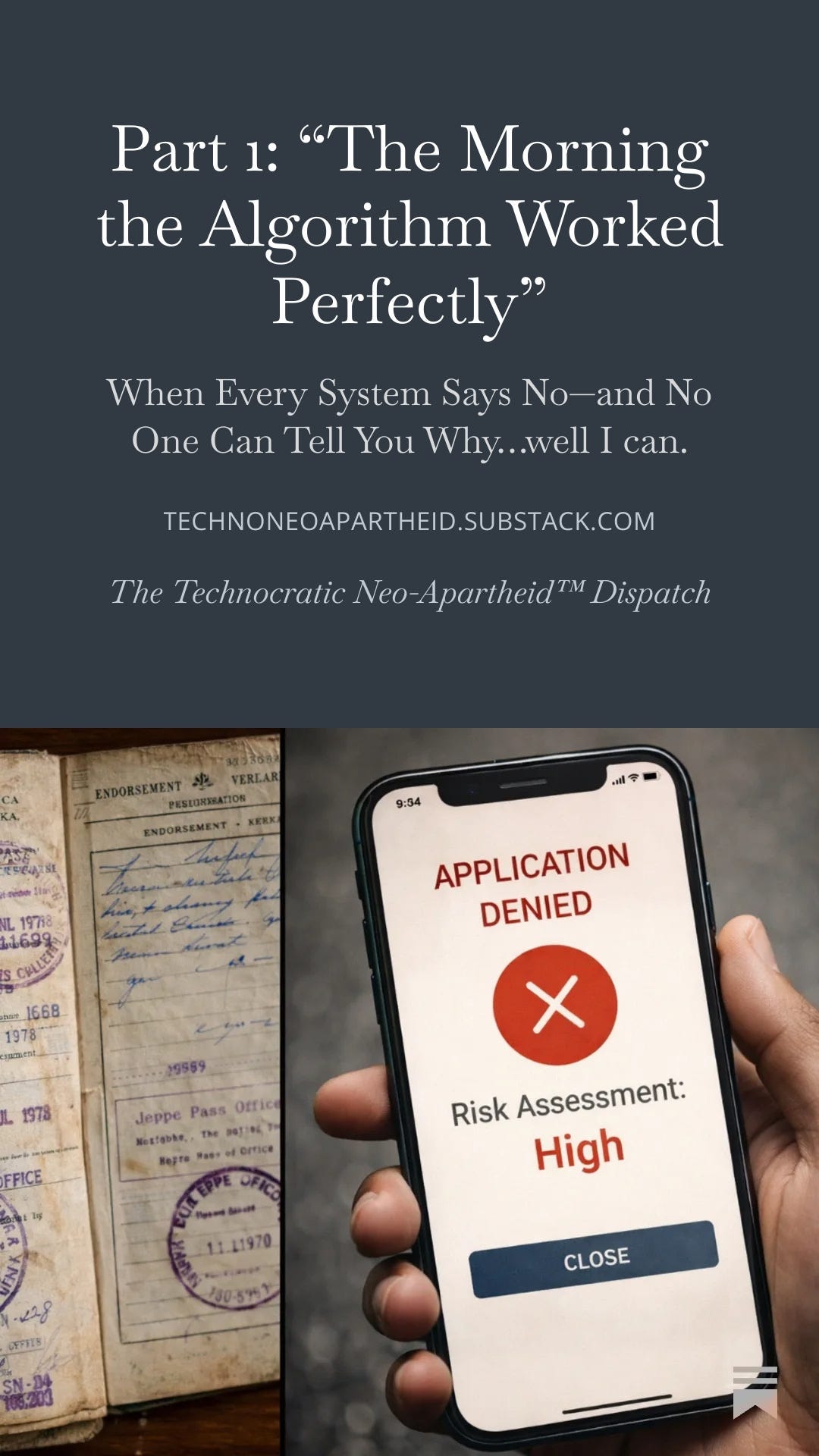
Here's the first part for those who missed it!
(https://open.substack.com/pub/technoneoapartheid/p/part-1-the-morning-the-algorithm?utm_source=share&utm_medium=android&r=1l9rnm)