“Food for Thought”: Serving Up Thomas Sowell’s Sacralized Scraps
How Hamza Yusuf and Zaytuna College Deliberately Served Anti-Black Racial Revisionism Under the Guise of Islamic Scholarship

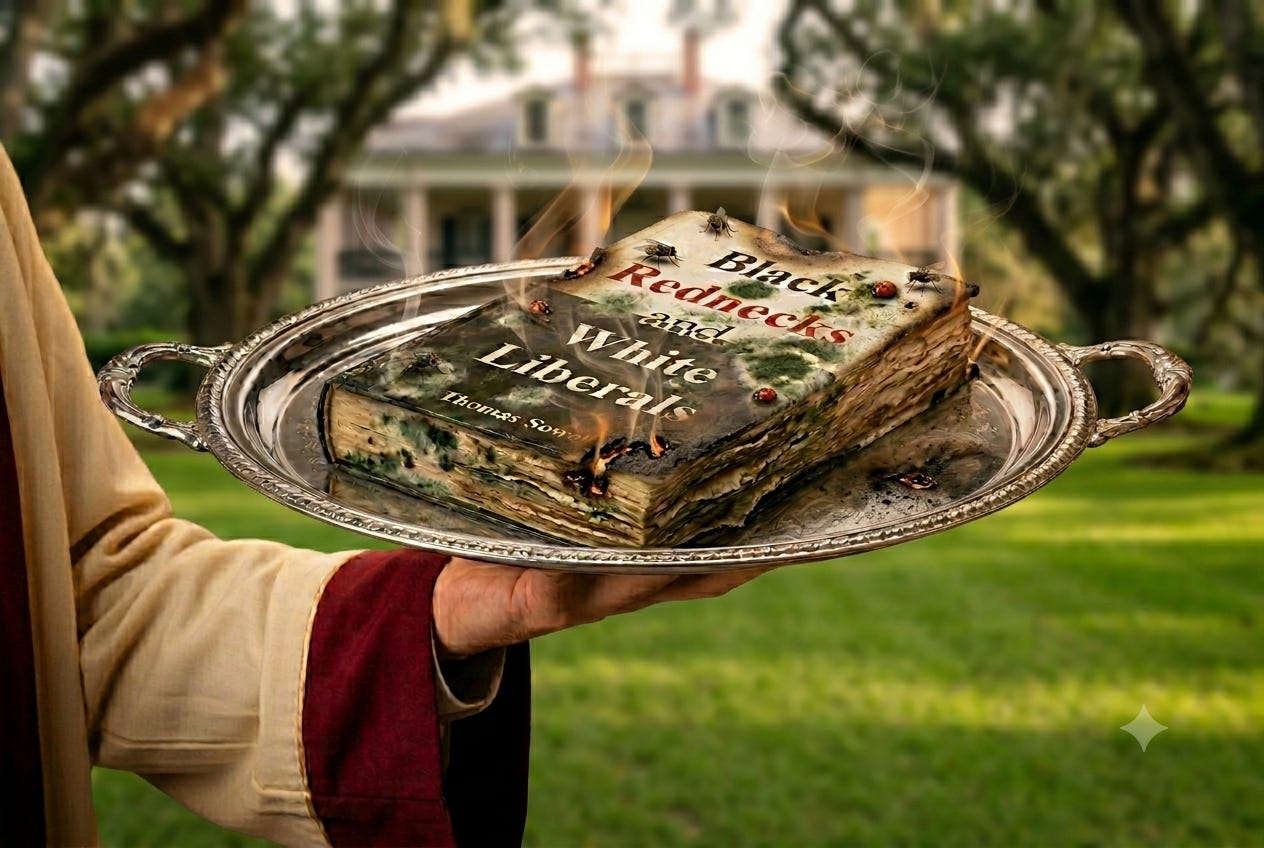
INCIDENT TRACE
The Zaytuna College Instagram account is verified. The post carries the institution’s name and its seal. It goes up on May 25, 2023, and it does not arrive alone. It arrives with a book cover: Black Rednecks and White Liberals by Thomas Sowell. It arrives with a red medallion stamped with the gold Arabic letters اقرأ, Iqra’, Read, the first word of the first revelation, and beneath that, the words First Command Book Club. It arrives with a time and an invitation: join us Sunday, May 28th, 3 pm PDT, 6 pm EDT, with President Hamza Yusuf. The Zaytuna bookstore stocks the book. The First Command Book Club page names the guest scholar: Dr. Abdullah bin Hamid Ali, Associate Professor of Islamic Law and Prophetic Tradition at Zaytuna College, Founding Director of the Lamppost Education Initiative.
The post does not simply announce the event. It opens with a quotation, framed as food for thought. The quotation is Thomas Sowell’s: racism was neither necessary nor sufficient for slavery, whose origins antedated racism by centuries. Racism was a result, not a cause, of slavery.
Thomas Sowell is a Hoover Institution economist. He is not a historian. He is not a sociologist. He is not a scholar of slavery, of racial formation, or of the specific legal and political architecture that produced American chattel slavery. His work on race has been dismissed by historians working in the very fields he claims to interpret, criticized for sloppy treatment of cultural evidence, and celebrated without exception by the conservative white intellectual infrastructure that has spent decades building the case that anti-Black racism is either exaggerated, manufactured, or self-inflicted. His name is not reached for by accident. His book is not placed on a syllabus in good faith by anyone familiar with the scholarly record. By May 2023, his function in the American racial discourse is not ambiguous. It is a known quantity.
Zaytuna College posts this. Hamza Yusuf presides over the discussion of it. Abdullah bin Hamid Ali is the scholarly instrument through which it is delivered. The word of Allah’s first revelation hangs above all of it.
The institution’s comment section fills up. Praise and accolades arrive. Questions filter in. One comment, posted the same day, names what the institution will not: Zaytuna’s endorsement and even the entertainment of Sowell’s claim that white supremacy was just an aftereffect of slavery is intellectual dishonesty at its finest.
The institution does not respond. The book club session proceedsbas planned. A participant later describes it as a superficial delve into a huge and controversial territory. The Zaytuna bookstore continues to stock the book.
THEY MEANT WHAT THEY SAID
Thomas Sowell’s claim, as Zaytuna College posted it, is not a provocation designed to stimulate genuine inquiry. It is a position with a specific architecture and a specific destination. Its components require examination before its consequences can be fully understood.
The claim operates in two identifiable movements. The first movement asserts temporal precedence: slavery is older than racism, therefore racism cannot be slavery’s cause. The second movement asserts causal inversion: racism did not produce slavery, slavery produced racism. Together these two movements attempt to accomplish something precise. They aim to completely remove anti-Black racial intent from the foundation of American chattel slavery. They transform the most elaborately engineered system of racial subjugation in the modern world into a generic human institution that happened, incidentally and belatedly, to generate racial feeling as a byproduct.
This is not a heterodox position that even deserves a hearing. It is a discredited position that has been answered, thoroughly and repeatedly, by the historians whose field Sowell entered without credentials and whose evidence he selectively deployed without rigor. The answer to Sowell’s claim is not a matter of ongoing scholarly debate. The historical record closed this question decades ago.
What remains open is only the question of why an institution with the resources, the scholarly personnel, and the Islamic mandate of Zaytuna College would reach for a claim the historical record has closed, frame it as food for thought, and place the first word of divine revelation above it.
The stakes are not abstract. For Black Muslims sitting inside the institutions of American Islam, the claim that racism was merely an aftereffect of slavery does specific damage. It severs the causal chain between the white supremacist ideology that targeted African people specifically and the conditions that African American communities continue to navigate today. If racism was not the cause but the consequence, then the racial architecture of American society, its housing policy, its carceral system, its labor markets, its medical infrastructure, its educational geography, all of it loses its historical grounding. It becomes the residue of a now-defunct institution rather than the ongoing operation of an engineered racial order. And if it is residue rather than operation, then grievance is nostalgia, remedy is overreach, and the Black Muslim who names what is happening to his community is not bearing witness. He is performing victimhood.
This is what the claim does. Not as a side effect. As its primary function.
For non-Black Muslims, and particularly for immigrant Muslim communities navigating their own complex relationship to American racial hierarchy, the claim offers something more intimate: relief. The immigrant complicity calculus has always required an explanation for Black conditions that does not implicate the racial order in which the immigrant seeks to ascend. Sowell provides that explanation with the credibility of a Black conservative economist and the institutional imprimatur of a major American Islamic college.
The message received is not a scholarly finding about historical causation. The message received is that the most credentialed engagement with this question confirms what the complicity calculus already needed to be true: that Black suffering is explained by something other than the system that non-Black Muslims are learning to navigate and benefit from.
That is the function of the claim. That is what Zaytuna delivered on May 25, 2023. What remains is to establish, precisely and without remainder, that the historical record does not support it, never supported it, and that everyone in that room on May 28th had sufficient access to the record to know it.
THE HISTORIAN’S VERDICT
Thomas Sowell is an economist. This is not a peripheral detail. It is the first fact the historical record requires, because the claim Zaytuna posted as food for thought is not an economic claim. It is a historical one, and the historians who have spent their careers building the evidentiary record of American slavery and racial formation did not leave it unanswered.
What the historical record establishes is not a counter-opinion to Sowell’s position. It is the documented, peer-reviewed, award-winning scholarly consensus of the field he chose to trespass in. Four clear and undisputable lines of evidence converge on the same conclusion. They are presented here not as debate but as verdict.
Winthrop Jordan and the Evidence of 1550
In 1968, historian Winthrop D. Jordan published White Over Black: American Attitudes Toward the Negro, 1550–1812, a work that won the National Book Award and remains, more than five decades later, the definitive scholarly account of racial attitudes in colonial America. Jordan’s research begins not with the institution of American slavery but with the moment of first contact between English people and Africans, more than a century before the Virginia slave codes entrenched racial chattel slavery as law.
What Jordan documents across that century is not a racial blank slate. English perceptions of Africans as categorically different, as associated with darkness, with savagery, with a nature suited to subordination, precede the formal institution of race-based slavery in the American colonies. These perceptions of difference are not a rationalization that arrives after the fact to justify an already-operating system. They are constitutive elements of how the system was conceived, how it was argued for, and how it was made to seem natural to those who built and benefited from it.
Sowell’s claim requires that racism postdate slavery by centuries. Jordan’s evidence requires that racial perception and the institution it justified developed in direct relationship with each other, each reinforcing and enabling the other, across the precise period Sowell dismisses with an economist’s confidence and a historian’s absence.
Edmund Morgan and the Deliberate Architecture
In 1975, historian Edmund Morgan, Sterling Professor of History Emeritus at Yale University, published American Slavery, American Freedom: The Ordeal of Colonial Virginia. Morgan’s argument dismantles Sowell’s causal inversion not by disputing that slavery preceded formal racial codification in some abstract sense, but by documenting precisely how and why the racial codification was constructed, by whom, for what purpose, and at what political moment.
Morgan’s evidence centers on Bacon’s Rebellion of 1676, the violent uprising that revealed to Virginia’s planter elite the dangerous potential of alliance between poor white indentured servants and enslaved Africans, both of whom shared grievances against the colonial oligarchy. The elite’s response to that threat was not organic, not cultural, not the slow accumulation of racial feeling. It was legislative, deliberate, and precisely targeted. A series of laws codified racial distinctions, entrenched Black slavery as a permanent hereditary condition, and extended new privileges to poor whites specifically to purchase their loyalty along racial lines.
This is not racism as aftereffect. This is racism as political engineering, deployed by identifiable actors, through identifiable legal mechanisms, to solve a specific political problem. Morgan names the architects. He dates the legislation. He traces the political logic from the threat to the response. What Sowell describes as an incidental cultural development, Morgan documents as a calculated institutional construction. These are not compatible accounts of the same history. One is history. The other is cover.
Barbara Jeanne Fields and the Ideology Built to Order
In 1990, historian Barbara Jeanne Fields published “Slavery, Race and Ideology in the United States of America” in the New Left Review, a work that has since become one of the foundational texts in the scholarly understanding of racial formation in America. Fields’s argument addresses Sowell’s position with a precision that makes the encounter feel almost surgical.
Fields establishes that race is not a biological fact, not a cultural inheritance, and not a psychological inevitability. Race is an ideology, produced at a specific historical moment, to perform specific work. That work was to resolve a contradiction that the architects of American liberty could not otherwise survive: the contradiction between the natural rights doctrine on which the republic was founded and the chattel enslavement of African people on which its economy depended. Those holding liberty to be inalienable and holding Africans as slaves were bound to construct race as a self-evident truth, because without it the entire moral architecture of the republic collapsed.
Race and slavery do not exist in the sequential relationship Sowell asserts, with slavery arriving first and racism trailing behind as a cultural residue. They develop in tandem, each requiring and producing the other, within the specific historical conditions of colonial and early republican America. To claim that racism was neither necessary nor sufficient for American chattel slavery is to intentionally misunderstand, at the most fundamental level, what American chattel slavery was. It was not a generic labor institution that happened to involve Africans. It was a racial institution, constructed through racial ideology, sustained by racial law, and reproduced through racial violence. Racism was not its aftereffect. Racism was its operating system.
Ibram X. Kendi and Five Centuries of Documented Evidence
In 2016, historian Ibram X. Kendi published Stamped from the Beginning: The Definitive History of Racist Ideas in America, winner of the National Book Award for Nonfiction. Kendi’s contribution to this evidentiary record is not simply a counter-narrative to Sowell’s position. It is a five-hundred-year documented history of how racist ideas were produced, by whom, for what purpose, and in what relationship to the racist policies they were designed to justify and sustain.
Kendi’s central finding directly inverts the conventional understanding that Sowell’s claim depends on. Racist ideas did not arise from ignorance, from cultural habit, or from the organic development of human prejudice. They were created, deliberately and purposefully, to justify racist policies and the racial inequities those policies produced. The causal arrow does not run from slavery to racism. It runs from the need to justify racial exploitation to the production of racist ideas built to serve that justification. This is not the direction Sowell’s claim points. It is the opposite direction, documented across five centuries of American intellectual history, in the words of the architects of racial ideology themselves.
This is the scholar Abdullah bin Hamid Ali has made a sustained, public, and documented project of discrediting.
Bin Hamid Ali’s public record on this point is not ambiguous and not recent. Across multiple years and multiple platforms, he has characterized the scholarly tradition Kendi represents as having anti-white aspects that Muslims must abandon, named Kendi explicitly as a race hustler whose ideas are incompatible with Islamic teaching on race, and framed the entire field of structural racism scholarship as a mechanism for convincing Black people that racism surrounds them when, in his public account, meaningful progress had already been achieved. He has gone further still, redefining institutional racism itself as the manipulation of non-white people into negative beliefs about American racial society, an inversion that functions identically to Sowell’s causal inversion of racism and slavery. In Bin Hamid Ali’s public framework, naming structural racism is the racism. The scholar whose five-century evidentiary record most thoroughly dismantles Sowell’s claim is, in Bin Hamid Ali’s telling, a hustler leading Black people away from their own progress.
This is the scholar Hamza Yusuf selected to preside over the discussion of Thomas Sowell’s claim that racism was merely an aftereffect of slavery. The selection was not incidental, it never is. A guest scholar with no public record on these questions would have been available. A guest scholar with a critical or even ambivalent relationship to Sowell’s position would have been available. Zaytuna College is an accredited institution with access to the full range of Muslim scholarship in America.
What Hamza Yusuf chose was the one prominent Black American Muslim scholar whose documented public record had already done the work of discrediting the historians whose evidence refutes what the book club was promoting.
Bin Hamid Ali did not arrive at the First Command Book Club as a neutral Islamic intellectual engaging a difficult text. He arrived as the pre-selected answer to the objection. His presence was not there to complicate Sowell. It was there to insulate him.
The Verdict
Again, Sowell is an economist. Jordan, Morgan, Fields, and Kendi are historians. The distinction is not at all credentialist. It is essentially evidentiary. Historians of American slavery work from primary documents, from colonial legislation, from plantation records, from legal archives, from the words of the people who built the system and the people who survived it. Sowell works from the ideological requirements of a conservative political project that needs Black suffering to be explained by something other than white supremacy. James B. Stewart, writing in the Journal of African American History, named what Sowell does in Black Rednecks and White Liberals precisely: sloppy treatment of the nature of cultural exchanges leading to obvious contradictions. This is not a fringe assessment. It is the assessment of a peer-reviewed journal dedicated to the scholarly study of African American history, applied to the specific text Zaytuna College selected, stocked in its bookstore, and placed under the first word of divine revelation.
The historical record did not leave Sowell’s claim standing. Zaytuna College knew this, or was obligated by its own scholarly pretensions to know it, before the post went up on May 25, 2023. And the scholar they selected to lead the discussion had spent years on public record attacking the historians who proved it.
THE TRUE FUNCTION OF THE CLAIM
What Sowell’s causal inversion accomplishes is not accidental to its construction. The political and ideological work it performs is not a side effect of a scholarly argument that happens to have political implications. There is no scholarly argument to be made here. There is a political project dressed in the language of scholarship, and its function can be mapped with precision.
Begin with what the inversion removes.
If racism was merely an aftereffect of slavery, then American chattel slavery has no racial architects. It has no designers who looked at African people specifically and built a system of permanent hereditary bondage around the specific fact of their Blackness.
The papal bulls authorizing the enslavement of Africans did not happen. The Virginia Slave Codes did not happen. The Dred Scott decision, in which the Supreme Court of the United States ruled that Black people had no rights that white people were bound to respect, did not happen as an expression of racial ideology, because racial ideology, in Sowell’s account, was still catching up to the institution it was supposedly producing.
The deliberate legislative engineering that Edmund Morgan documented, the conscious post-Bacon’s Rebellion decision by Virginia’s planter elite to purchase poor white loyalty with racial privilege, did not happen as an act of racial construction. It happened as an incidental cultural development whose racial character was still forming.
Strip the racial intent from the architecture and the architecture becomes all but invisible. And when the architecture becomes invisible, everything built on top of it becomes inexplicable.
Jim Crow is no longer the legal continuation of a racial order whose foundations were laid in the colonial period. It is an anomaly, a detour, a deviation from a society that was otherwise making progress.
Redlining is no longer the federal government’s deliberate application of racial geography to housing markets. It is a policy dispute, unfortunate in its consequences, unconnected to any continuous racial project.
Mass incarceration is no longer the carceral expression of a system that has always required the containment and exploitation of Black bodies. It is a crime problem with a demographic dimension that reasonable people can disagree about.
This is the destination of the causal inversion. Not a historical debate about the sequencing of racism and slavery in the seventeenth century. A complete exculpation of the racial order as it currently operates. If the foundation was not racial, then nothing built on the foundation is racial either.
If nothing is racial, then Black grievance is without object, Black analysis is without basis, and Black demands for structural remedy are without justification.
The cultural pathology argument that runs through the rest of Black Rednecks and White Liberals is not a separate claim from the causal inversion. It is its necessary companion. The causal inversion removes racial intent from the system. The cultural pathology argument fills the explanatory vacuum that removal creates.
If white supremacy did not engineer Black subjugation, then Black subjugation must be explained by something internal to Black communities. The redneck culture claim is Sowell’s answer to that vacancy: Black conditions are the product of a dysfunctional cultural inheritance, transmitted through proximity to poor Southern whites, and sustained by white liberals who celebrate that dysfunction as authentic Black identity rather than correcting it.
Together these two moves form a closed and self-sealing system. The system that produced Black conditions is exonerated. The communities that bear those conditions are indicted. And the people who name the system are identified as the real problem, the white liberals and race hustlers who keep Black people invested in grievance rather than culture change. The circle closes completely. There is no entry point for structural critique, because the structure has been analytically dissolved. There is no entry point for historical accountability, because the history has been causally rearranged. There is no entry point for Islamic moral clarity on anti-Black racism, because the Islamic institution that should be providing that clarity has placed its presidential authority and its Iqra’ medallion behind the claim that there is nothing structural to be morally clear about.
This is what was posted on May 25, 2023. This is what was discussed on May 28th. This is what the Zaytuna bookstore continues to stock.
The confirming character of this system is not lost on the people who have found it most useful. Thomas Sowell is not celebrated across the full ideological spectrum of American intellectual life. He is celebrated in a specific corner of it, by specific institutions, for specific reasons, with a consistency that itself constitutes evidence of the claim’s function.
PragerU, the conservative media organization whose curriculum has been adopted into the official public school standards of the State of Florida, has produced dedicated video content on Sowell’s work on race, including a featured episode asking whether systemic racism is really to blame for racial disparities. The Daily Wire, Ben Shapiro’s media platform, has featured Sowell in prominent conversation on social justice and racial inequality. Fred Barnes, executive editor of The Weekly Standard and Fox News commentator, provided the back-cover endorsement for Black Rednecks and White Liberals, describing Sowell as America’s foremost public intellectual. The Claremont Review of Books, flagship journal of the Claremont Institute whose intellectual infrastructure has shaped the Christian nationalist and MAGA political project, has featured laudatory treatment of Sowell’s racial arguments as serious and necessary correctives to the scholarly consensus.
These are not incidental admirers. They are the institutional architecture of white conservative and Christian nationalist intellectual life in America. They reach for Sowell on race with the enthusiasm of people who have found precisely what they were looking for. His claim that racism was merely an aftereffect of slavery does not circulate in these ecosystems because white conservatives have developed a sudden investment in Black intellectual production. It circulates because it provides white supremacist ideology with a Black face, an economist’s credentials, a Hoover Institution address, and the cover of heterodox scholarly courage. It gives the racial order’s defenders the one thing they most require: a Black scholar willing to say that the racial order is not the problem.
Zaytuna College knew who reaches for this tool and what they use it to build. They reached for it anyway.
They placed it under Iqra’. They called it food for thought. The question requiring an answer is not whether this was accidental. The question is how the mechanism was assembled, who was selected to operate it, and what the assembly reveals about the institution that built it.
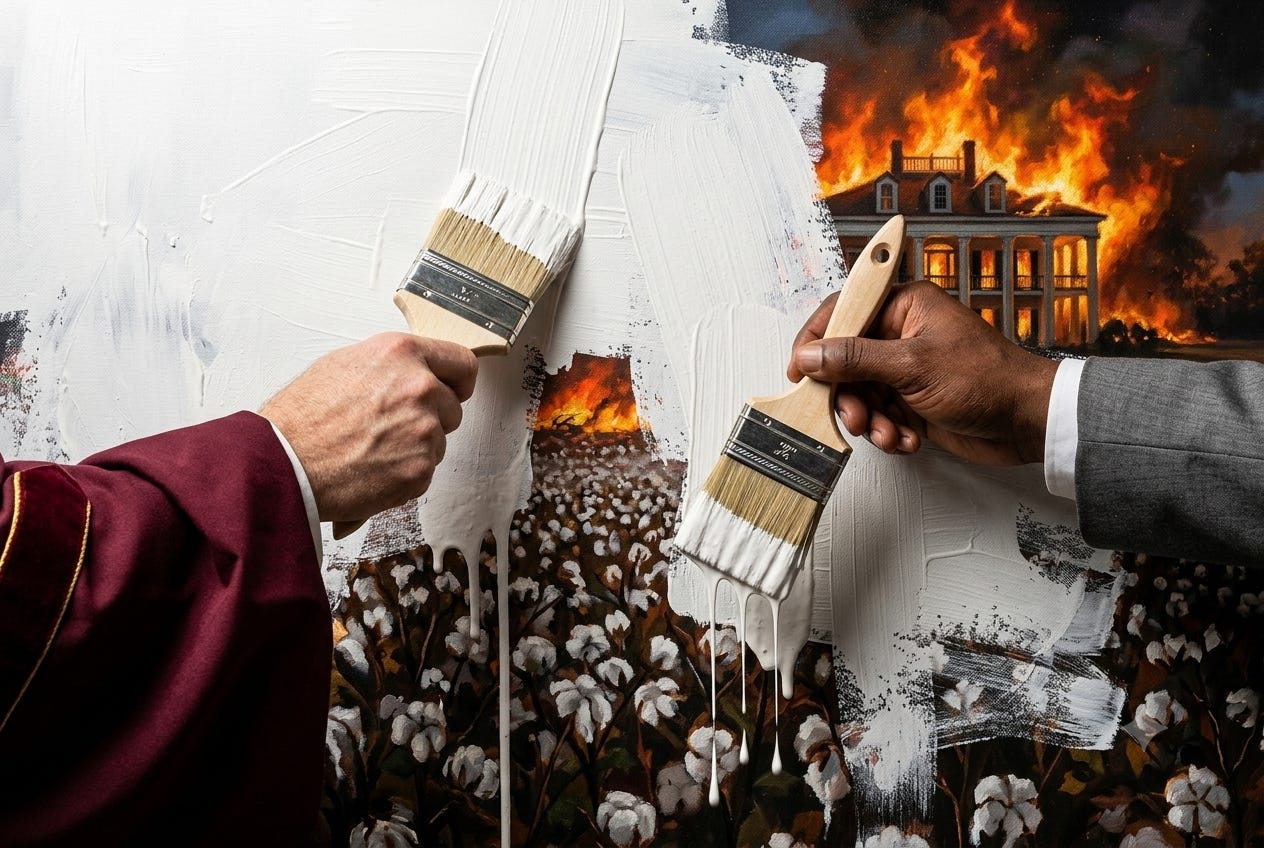
THE MINBAR THAT ENDORSED IT
Zaytuna College is not a book club. This distinction requires stating plainly because the First Command Book Club carries its own branding, its own medallion, its own Iqra’ seal, and its casual register invites a casual assessment of what it actually is. Zaytuna College is the first accredited Muslim liberal arts college in the United States. Its president, Hamza Yusuf, is arguably the most influential English-language Islamic scholar of the last three decades, a figure whose reach extends across continents, whose endorsements shape curricula, whose platforms form the intellectual architecture through which hundreds of thousands of Muslims in the West understand their tradition.
When Zaytuna posts a claim about slavery and racism, frames it as food for thought, and places اقرأ above it, it is not a reading group sharing an interesting perspective. It is an institution deploying its full authority to normalize a position. The weight of that authority is the point. It is precisely what was being deployed.
This authority did not arrive at the Sowell book club without a prior record. Seven years before the First Command Book Club posted Thomas Sowell’s causal inversion as food for thought, Hamza Yusuf stood on a stage at the Reviving the Islamic Spirit conference in Toronto, Canada, in December 2016, and told a Muslim audience, in response to a question about solidarity with Black Lives Matter:
“The United States is, in terms of its laws, one of the least racist societies in the world. We have some of the best anti-discriminatory laws on the planet. We have between 15,000 to 18,000 homicides a year, 50 percent are black on black crime. There are twice as many whites that have been shot by police but nobody ever shows those videos. It’s the assumption that the police are racist and it’s not always the case.”
This statement requires no interpretive apparatus. It is Sowell without the footnotes. It is the causal inversion without the economist’s credentials. It redirects attention from documented police violence against Black people to Black on Black crime statistics. It frames the assumption of police racism as the problem rather than the racism itself. It positions the United States as a society whose legal architecture has already addressed racism, making structural grievance an artifact of assumption rather than a response to documented reality. The register is different from the 2023 book club post. The position is identical.
The response from the Muslim community was immediate and unambiguous. Shaykh Abdullah Hakim Quick stated publicly that Muslim leaders who do not recognize the systematic subjugation of Black people and do not speak clearly against organized racism should step down and keep their mouths shut. The Muslim Anti-Racism Collaborative documented the controversy as emblematic of toxic and divisive racial discourse within the American Muslim community. The criticism was broad, sustained, and grounded.
The ecosystem activated within days.
Abdullah bin Hamid Ali, Associate Professor of Islamic Law and Prophetic Tradition at Zaytuna College and Founding Director of the Lamppost Education Initiative, published a response essay on his own platform. In that essay he described the Black Muslim scholars, activists, and community members who had criticized Hamza Yusuf as sharks attacking a wounded man at sea, characterizing legitimate accountability as opportunistic predation and principled critique as the settling of old vendettas by commoners with misinformed opinions. Hamza Yusuf himself then endorsed the essay publicly, directing his own followers to read it, describing Ali as his friend and colleague of many years, a man he loves deeply, whose criticisms he accepts as valid. The endorsement appeared on the Lamppost platform. The relationship was declared in public, in the aftermath of the most significant anti-Black controversy of Hamza Yusuf’s public career, at the precise moment when that relationship was performing its most visible function.
This is the relationship that produced the 2023 book club. Not an institutional decision made by strangers operating at arm’s length. A documented personal and professional alliance, forged and publicly confirmed in the heat of an anti-Black controversy seven years earlier, now mature enough to deploy its full apparatus: the Zaytuna platform, the presidential imprimatur, the Lamppost scholarly credentials, the First Command Book Club branding, and Thomas Sowell’s causal inversion of the relationship between racism and slavery, presented to the Muslim community as food for thought.
Abdullah bin Hamid Ali was not selected for the Sowell book club because he was the most qualified Islamic scholar available to discuss American racial history. He was selected because his documented public record made him the precise instrument the event required. That record is extensive, consistent, and publicly available.
Bin Hamid Ali has maintained a sustained, documented campaign against the structural racism scholarship that most directly challenges Sowell’s position. He has characterized the scholarly tradition represented by Kendi and the analytical framework represented by Critical Race Theory as having anti-white aspects that Muslims must abandon. He has described scholars who document structural racism as race hustlers leading Black people away from their own progress. He has redefined institutional racism itself, not as the documented operation of racially disparate systems but as the manipulation of non-white people into believing negative things about race in American society, an inversion that functions identically to Sowell’s causal inversion of racism and slavery. He has publicly stated that white supremacy and racism are not the primary concerns he needs to attend to, and that the wounds of African Americans are self-inflicted insofar as Black communities use victimhood as an excuse rather than pursuing collective empowerment.
These positions were not private. They were posted on a verified public platform, dated, and attributable. They represent not a moment of rhetorical imprecision but a coherent, sustained ideological framework that aligns precisely with the conservative white racial infrastructure that Sowell serves. Bin Hamid Ali reaches the same destinations Sowell reaches. He travels there through Islamic scholarly language, through the authority of his Zaytuna faculty position, and through the reach of the Lamppost Education Initiative, which has operated for more than fifteen years as the platform through which his influence extends beyond Zaytuna’s walls while his Zaytuna appointment lends that platform institutional legitimation.
The Lamppost platform’s ideological character is not ambiguous. Among the featured conversations hosted under its banner is an appearance by Owen Benjamin, a figure with a documented public record of antisemitism and white nationalist adjacent rhetoric, who was banned from multiple mainstream platforms for hate speech. The conversation was framed on the Lamppost platform around avoiding being brainwashed, manipulated, and overcome by victim consciousness. The choice of interlocutor, and the framing of the conversation, are consistent with the ideological commitments that define the platform’s treatment of race, racism, and Black grievance across its fifteen-year operation.
Bin Hamid Ali has also published, through the Lamppost platform, a book examining the presence and treatment of Black and African people in pre-modern Arab-Muslim consciousness. The publication performs racial awareness. It signals scholarly seriousness about anti-Black racism in Islamic intellectual history. It provides, in advance, the credential that preemptively answers the critique this piece is making: how can the author be anti-Black if he wrote a book about anti-Blackness in Islamic history?
The answer is that the book and the public record exist in direct contradiction, and the contradiction is the point.
The publication is not evidence of genuine engagement with anti-Black racism. It is the shield, manufactured and positioned precisely to deflect the accountability that the public record demands. It is Performance Architecture™: the visible performance of racial concern designed to protect the operational reality of racial complicity from scrutiny.
This is the man Hamza Yusuf selected. This is the platform he represents. This is the relationship, documented across seven years and two major controversies, that produced the First Command Book Club’s consecration of Thomas Sowell’s claim that racism was neither necessary nor sufficient for the enslavement of African people.
The word of Allah’s first revelation was placed above this. Iqra’. Read. The institution has been reading. The question is whether the community will read the institution.
CULTIVATING THE MANAGED AND MANAGEABLE MUSLIM™
The immigrant complicity calculus moves through the body of the Muslim community the way doctrine moves: absorbed before it is examined, operative before it is named, structural before it is visible. It does not require confession or declaration. It requires only the accumulated weight of institutions, platforms, book clubs, and credentialed scholars consistently directing Muslim attention away from Black suffering and toward the explanations that make Black suffering nobody’s responsibility. It requires only that the language of Islamic tradition, the vocabulary of classical scholarship, the authority of the verified account and the presidential imprimatur, be placed in consistent service of the racial narrative that the community has the most to gain from accepting. By the time it becomes visible it has already done its work. What Zaytuna posted on May 25, 2023 was not the introduction of the calculus into the community. It was the calculus, mature and institutionally confident, showing its face.
The Managed and Manageable Muslim™ is the product of this calculus operating at scale and over time. He is not necessarily a person of malice. He is a person of formation. He has been formed, through the platforms, the institutions, the book clubs, the Lamppost essays, and the Zaytuna syllabi of the neo-traditionalist ecosystem, to receive claims about Black suffering with a skepticism he does not apply to claims about his own community’s dignity. He has been formed to experience Black Muslim critique of anti-Black racism within Islamic institutions as a political intrusion, a departure from proper Islamic concern, an importation of secular ideology into sacred space.
He has been formed to find Sowell stimulating rather than disqualifying, to call the causal inversion food for thought rather than what the historical record requires him to call it, which is false.
He has been formed, in short, to be manageable: to present no meaningful resistance to the anti-Black racial order operating around him, and to provide, through his silence and his equivocation and his calls for balanced dialogue, the non-Black Muslim community’s contribution to that order’s continued operation.
The Black Muslim who sits inside these institutions occupies a different position in this formation. For him, the Managed and Manageable Muslim™ framework is not an external observation about someone else’s community. It is the water he is asked to breathe. Every time an Islamic institution platforms Thomas Sowell, every time a Zaytuna book club places the causal inversion of racism and slavery under the banner of Iqra’, every time a Lamppost essay describes Black accountability as sharks attacking a wounded man, the Black Muslim inside these institutions receives a message that his own assessment of his own community’s conditions is ideologically compromised, spiritually immature, and intellectually inferior to the considered position of the scholars whose authority the institution has invested in. He is being managed. The institution is the management. The scholars are the managers. The book club is the training session.
James Baldwin understood what is at stake when the terms of a debate include the humanity of one of its parties. We can disagree on everything, the formulation goes, as long as it is not about my humanity.
Zaytuna College, in selecting Thomas Sowell’s claim as food for thought, in placing it under Islamic scholarly authority and divine revelation’s first word, placed Black humanity on the table as a debatable proposition.
The claim that racism was merely an aftereffect of slavery is not a historical hypothesis that reasonable people can evaluate with equanimity.
It is a claim about whether the specific targeting of African people for permanent hereditary bondage was a racial act.
It is a clear claim about whether the suffering that followed from that act, and the suffering that continues to follow from the infrastructure built to sustain and extend it, is connected to anything that can be named, addressed, or remedied.
It is a claim, in other words, about whether Black people’s account of their own conditions is accurate or manufactured.
To place that claim under Iqra’ and invite the community to discuss it with President Hamza Yusuf is not Islamic intellectual formation. It is the Islamic institutional production of Black erasure.
The non-Black Muslim who received this event as legitimate scholarly engagement, who found Sowell’s position thought-provoking rather than disqualifying, who described the book club session as a worthwhile if superficial exploration of controversial territory, was not making an intellectual error. He was completing his formation. The ecosystem had prepared him for exactly this response. The Lamppost platform had spent years characterizing structural racism scholarship as race hustling. The Zaytuna president had spent years redirecting questions about anti-Black police violence toward Black on Black crime statistics. The guest scholar had spent years publicly insisting that white supremacy was not his primary concern and that the wounds of African Americans were self-inflicted. By the time the book cover appeared on the verified Instagram account, the community had already been primed to receive it. The book club was not the beginning of the formation. It was the examination.
The Black Muslim reading this piece has already known something was wrong. He knew it when the post went up. He knew it when the comment section filled with praise. He knew it when the session proceeded and the institution did not course-correct. He may not have had the full evidentiary record in hand. He may not have been able to name every mechanism or trace every institutional connection. But he knew what his community has always known, what the tradition he carries in his bones has always known, what every African and African American Muslim from the enslaved scholars of the antebellum plantations to the converts of the Civil Rights movement has known: that the people who benefit from the erasure of Black suffering will reach for any instrument available to accomplish that erasure, and that when those instruments are dressed in Islamic scholarly clothing and placed under the first word of divine revelation, the erasure does not become less violent. It becomes more so.
THE FINAL VERDICT
Zaytuna College selected Thomas Sowell’s Black Rednecks and White Liberals for its First Command Book Club.
Its president, Hamza Yusuf, presided over the discussion. Its Associate Professor of Islamic Law, Abdullah bin Hamid Ali, served as guest scholar.
The institution posted Sowell’s claim that racism was neither necessary nor sufficient for slavery, framed it as food for thought, and placed the first word of divine revelation above it.
The Zaytuna bookstore stocked the book. The event proceeded. The institution did not retract, correct, or acknowledge what it had done.
What it had done is this: it used the full weight of its institutional Islamic authority to normalize a historically discredited, politically motivated claim whose primary function is the exculpation of white supremacy and the erasure of Black suffering.
It did this not in ignorance. It did this with a president whose prior public record on anti-Black racism was already documented and contested.
They did this with a guest scholar whose sustained public campaign against structural racism scholarship had already made his ideological commitments visible to anyone willing to look.
They did this with a platform, a bookstore, a branding apparatus, and a divine invocation, all of it deployed in service of a claim that four National Book Award-winning and peer-reviewed historians had already answered, thoroughly and without ambiguity, before the post went up.
This is not a community that stumbled into an error. This is an institution that made a choice. The choice is clearly documented. The record is public. The historians have spoken. The evidentiary ledger is open.
What accountability requires is not a conversation. Zaytuna College has demonstrated, across seven years of documented positions, platform choices, and institutional decisions, that conversations about anti-Black racism within its walls are not conducted in good faith. What accountability requires is clarity: clarity about what was done, clarity about what it means, and clarity about what it reveals concerning the institution’s relationship to the Black Muslim community it claims to serve.
The first word of revelation is Iqra’.
Read.
We have read enough to know what's being said.
Appeasement can never be a feasible policy.
Often tried.
But the results often reflect the observable results like that in west Asia.
Appreciate your effort here.